|
How to Select Body Armor |
||||
Which Model of Concealable
Vest Should I Get?
|
||||
|
Protection is a % Game |
||||
|
REAL PROTECTION =
Assuming the threat doesnt notice your body armor, and target unprotected areas! For example, if your vest...
You have achieved 67% coverage. 95% times 70% times 100% equals 67%. (0.95 X 0.7 X 1.0 = 0.67 = 67%) 67%
is a superb score, but, if nothing else, this example should remind
you of the importance of training, tactics and common sense. Body Armor
will put the odds in your favor very substantially but
(just as in life) there are no 100% guarantees. |
||||
|
% of Threats Stopped by the Vest |
||||
|
As detailed on the Ballistic Protection Levels page, even Level II-A vests are adequate for the vast majority of pistol ammunition usually seen on the street. Level II and III-A offer more blunt trauma protection, and stop more of the unusual threats. But really the decision here is not so much a percentage protection decision, as personal preference pay a little more, for a slightly heavier and bulkier vest and know that if you ever take a hit on the vest you might possibly get off with a 3" or 4" bruise (~8 or 10 cm.), versus a cracked or broken rib. We cant make that call for you, other than to say we generally feel well protected with a Level II vest a nice balance between competing priorities. If all you can afford is Level II-A, yes, you might be missing a few per cent of the more unusual ammunition threats but in the big picture wearing your vest 100% of the time is MUCH more important. If you simply feel better knowing you have a III-A (the maximum in soft body armor) we cant argue with peace of mind. The one good rule of thumb is get a vest tested to stop the weapon you, or your partner, carries:
Tactically, one factor does strongly recommend a thicker Level II or III-A, over II-A being able to return fire more quickly and/or effectively. The extra thickness means more blunt trauma protection, and less felt impact or injury from bullets striking you. Thus you may be able to react faster and more effectively after being hit critical if you need to prevail in the confrontation, as well as just survive the hit. But, especially if you are wearing your vest for long periods of time, comfort often becomes the most important factor don't automatically assume Level III-A is the best for you.
Some aficionados are fond of expounding on the fact that their favorite Armor-Piercing (AP) 9 mm, or their 7.62 mm Tokarev pistol ammo, etc., etc., can go through that vest like a hot knife through butter! Indeed, you should be aware that some very rare and specialized pistol ammo CAN penetrate soft body armor. But what also needs to be said is that in the US AP pistol ammo is illegal and difficult to impossible to obtain (also all the calibers of AP rifle ammo usable in pistol variants). How often does the armed criminal take the time and trouble to find such rare ammo? Not very often, though obviously you must evaluate the threats YOU are likely to face. If you are a narcotics police officer after hard-core biker drug-gangs AP is possibly a concern. In 1999 one officer was just barely saved by his Level II vest from a drug dealer with a 7.62 mm Tokarev. So, for example, SWAT teams, and police officers making high-risk traffic stops, may be well advised to get Level III-A armour, just to be on the saf-ER side (there is never a 100% safe side). For the majority of law enforcement, security guards, and civilians, getting a Level III-A is money well spent for peace of mind and extra blunt trauma protection but probably not required on a percentage analysis. You must evaluate the threats YOU are likely to face.
Not to be confused with Rifle Plates, these 5" by 8" (~13 by 20 cm.) Steel, Kevlar®, or Spectra® inserts are designed to protect the vulnerable mid-chest/sternum area from blunt trauma. A great idea, highly recommended, but they are the icing on the cake not the cake. Vests are NIJ-certified WITHOUT a Blunt Trauma Pad.
The big question in Threat Levels is do you need Level III or IV rifle plate protection? Adding a PAIR of 10" by 12" Ceramic plates (~25 by 30 cm.) will add ~11 lbs. (5 kg.) to your 4 lb. vest (1.8 kg.)! (Plus it will double the cost of a $500 vest.) You can cut that down to ~6 lbs. (2.7 kg.) with Ultra-light Polyethylene plates but then the extra cost is ~$800. Generally, in U.S. urban areas, short-barreled firearms are the main threat because they are the type of weapon most often used by criminals. Worse, they are concealable you cant avoid something you cant see. You can more easily avoid the criminal with a rifle, seen from a distance. Once again, you must evaluate the threats YOU are likely to face. If rifles are a possible or probable threat, get some Level III or IV protection, as this is often the only option short of your vehicles engine block. (Or hoping that your car door will cut ~2,800 fps of rifle muzzle velocity in half so that your soft body armor might handle it!) A good compromise is a soft body armor vest for regular wear, with an optional carrier with built-in rifle plate pockets, such as our ProMAX Concealable with a Rifle Plate Pockets carrier. Or, more convenient for quick throw-on use, Rifle Plates in a separate modular Over-vest Carrier. This allows you to quickly add Rifle Plates when the tactical situation demands.
Analogous to the soft body armor discussion on AP how often are you faced with a criminal with Armor-Piercing ammo? The military in war zones, obviously. SWAT teams may be well advised to spend the extra money for the peace of mind and officer confidence. But it can also be argued that its not justified on the small percentage chance of ever facing such a threat. Once again, you must evaluate the threats YOU are likely to face.
However, Ceramic or Polyethylene Plates, versus Steel plates, are usually well justified on two factors. Firstly the weight savings you are looking at carrying ~3.3 or 5.5 lbs. per plate respectively, versus 9 lbs. for steel (~1.5 or 2.5 kg. versus 4.1 kg.). Over two plates that is 5 lbs. to 11 lbs, of weight savings (2.3 or 5 kg.). Furthermore there is less chance of ricochet or bullet splatter causing injury with a Ceramic or Polyethylene plate. The bullet tends to penetrate further into nonmetallic plates. (However, this also means that, in multi-hit situations, ceramic or Polyethylene loses protective integrity faster than steel.) Steel does have advantages its less expensive, and you dont have to worry about fracturing it if dropped/abused. If you can afford it, go light, but, as always, it's more important to wear second-best protection than to have nothing. |
||||
|
% Coverage of Vest |
||||
|
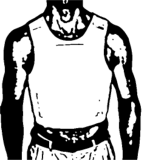
Rather than focusing on marginal differences of what the vest stops (outside of rifles), it is far more important to determine how much of your vital area is covered by the vest. Many concealable vests skimp on the amount of coverage of your body. A lot of people are worried about whether their vest will stop the exotic, uncommon threats but what's usually more important is to cover MORE of your body against the COMMON threats. By all means get a Level III-A for the uncommon threats, but the more important factor is how well the vest covers YOUR body (and that it is comfortable and concealable enough so that you actually wear it). If you hold a weapon in the side-angled Weaver stance, the target area exposed to the threat is your SIDE as much - or more - than your front. Full side protection is critical to achieve good percentage coverage of the body areas exposed to the threat. Excellent side coverage is illustrated by the photo below: Many vests are marketed that are just front and back, or only have extended, or partial, or scalloped side coverage. Look in the mirror when holding in a side-angled Weaver stance the large percentage of your upper body that would NOT be covered makes the problem obvious. However partial side vests do serve a purpose in high heat environments because they offer more ventilation and heat dissipation. If you cant, or wont, wear a full side protection vest in the summer get us to size you for partial side coverage that will be worn (and train yourself to face the threat in a front-facing, isosceles stance and then hope its just a single threat!)
Width Firstly, is the vest cut narrowly across the chest, to give maximum freedom of movement and comfort or cut widely for maximum protection? The coverage across the chest can vary by up to an inch or two (3 - 5 cm.) between brands for the same size. What is best for you really depends on your body type, how long you wear the vest each time, the level of threats, and your personal preference for more comfort and arm freedom, or more protection. Have the vest you are going to buy measured across the Chest between the armpits (measure the ballistic panel, NOT the cloth carrier) Length Secondly, most vests are designed to ride comfortably above a police officers duty belt. This is ideal for comfort for patrol officers on long shifts you wont wear a vest that jabs you in the throat when you bend over, or sit down. But, if you dont wear a duty belt (or have a long torso), you are missing an extra one to two inches (~3 to 5 cm.) of coverage on your abdomen. But it is also critical to not to get TOO LONG a vest. Too long, and it will ride up when you sit or bend, and jab you in the throat.
Unless you see it in writing otherwise, you can safely assume that a bulletproof vest is the standard, shorter, duty belt length. (And just to add confusion, one company's Regular can be another company's Short.) Generally a standard, size Large vest is ~12" to 12.5" (~30 - 32 cm.) measuring the ballistic panel (NOT the cloth carrier) front centerline the SHORTEST distance from the bottom of the neck scoop to the bottom of the vest. An extra one to two inches (~2 to 5 cm.) increases the coverage area of the vest by ~5% to ~10%. This is not an earth-shaking difference, but the feeling of coverage you get can be illustrated by holding 12" (~30 cm.) of a tape measure from the bottom of your throat down to the belly, versus 14" (~36 cm.) of coverage for an Extra-Long vest.
An exterior tactical vest with neck, shoulder and groin protection will weigh ~50% more than a concealable vest, and cost you ~ $750 or more. But you leave the criminal with little to aim at, other than your head, arms and legs. (And you can even cover the biceps, triceps, deltoid and armpit area with Upper Arm Protectors!) The percentage coverage is superb but heat build-up is more of a problem, and comfort and freedom of movement is slightly more restricted. But nothing beats that turtle-shell feeling, if you are investigating the sound of breaking glass at 3 in the morning! Will you have it on when the threat arrives? For SWAT teams, who have transit time to gear up, the answer is obviously yes, but for others highly dependent on the particular situation. Thus for tactical vests, the ease and quickness of getting the vest on is critical. Front-opening vests are a very attractive (though more expensive) option here. If you are buying a tactical vest find out EXACTLY how it is put on, to evaluate quickness. The other argument against exterior tactical vests is that it is visually obvious to the criminal to aim at unprotected areas. However, it can also be argued that it is unlikely that this visual clue will be acted on effectively in an adrenaline-charged confrontation. Regardless, our suggestion is that even tactical armor is best worn in the same color as the usual uniform or clothing to minimize the giveaway. Even better is to cover up with a jacket. Even if criminals know in the back of their mind that law enforcement almost always wear vests why remind them in the middle of a firefight! |
||||
|
% of Threat Time Vest is Worn |
||||
|
This is THE most important factor. Whether your vest covers 90% or 95% of pistol ballistic threats is marginal. And whether you are covering 50% or 70% of your vital areas is still less critical than going to ZERO protection with NO vest. Whatever vest you buy make sure it is comfortable enough to wear for the duration required. The best vest for you is the one you actually are wearing when shot! Also, its often the practical considerations listed above that are the most important, and can really only be thoroughly checked out with the vest in hand. Thus you should only buy a vest with a clear return policy, in case the vest wont work on your body, or in your situation. To repeat, especially if you are wearing your vest for long periods of time, comfort often becomes the most important factor don't automatically assume Level III-A is the best for you.
If you dont wear your vest in the daytime, or during the summer heat, youve just cut your average protection in half or less. A solution could be a partial side model for summer daytime use, keeping a full side protection model for the winter, and at night when it's cooler (and threats are more numerous, and less visible). Before sacrificing this much protection, it would be advisable to try adapting to a full side protection vest: A moisture-wicking undershirt, and/or a CoolMax® moisture-wicking carrier, and wearing the vest more loosely will help. This allows a little more air to circulate under the vest, and helps keep it from getting so sticky. Get a cooling system for your vest. The least expensive (i.e., quick and dirty) method is to pick up a freezable cold pack from your local pharmacy. Freeze it, wrap it in cloth, and insert inside the vest between the ballistic panel and the inner carrier fabric. BE VERY CAREFUL YOU DONT FREEZE YOUR SKIN it MUST be well-insulated from bare skin. The other problem to beware of, is stability of the cold pack. Or you can pick up one of the new Vest AC devices that plug into your vehicle's AC vents to direct cold, dry air BEHIND your vest next to your body.
...but kept at hand for emergencies, how fast you get it on is THE critical factor. The ideal here is a front-opening jacket vest. Instead of slipping on over your head, you can throw it on like a jacket, and quickly close the overlapping Velcro front flaps. Just as importantly, the concealment is built-in with the integral jacket. It doesnt do much good to get your vest on fast visible overtop of your clothes and then have the criminal take head and groin shots! We hope you have found this Guide useful. Please contact us if you have any questions or comments. |
||||
|
Related Pages: |
||||
|
Put
the odds in YOUR favor...
BulletProofME.com,
6705 Highway 290 West, Suite 502, Austin, Texas 78735 |
|
||||||||||||